
Two years ago, Professor Felix Ulombe Kaputu’s only company was the rats in his cell, fat from feasting on rotting corpses.
Imprisoned in Kinshasa, the capital of the Democratic Republic of the Congo, his skin had taken on a green hue from starvation and his blood pressure was dangerously low. Blisters that had formed in the back of his throat from dehydration made it difficult to swallow. Distraught, hungry and panic-stricken, but most importantly innocent, this accomplished and admired professor was accused of endangering national security and consequently imprisoned under abysmal conditions.
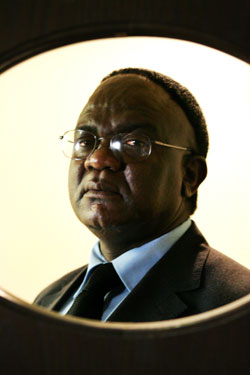
LASTING LOVE: Even though there is a looming death sentence for Professor Felix Ulombe Kaputu’s life, he still longs for the green hills of his homeland. “I can think of nothing else but going back to the Congo,” he said. (Photo: Emmanuelle Françoy)
Today, Professor Kaputu is a visiting assistant professor of literature at Purchase, State University of New York, after spending last year as a resident research scholar at the Du Bois Institute for African and African American Studies at Harvard.
His lips are curled up in a careful, almost shy smile, but his eyes speak of suffering and loss. While he is safe in the US thanks to academic and financial assistance from the New York Institute of International Education and the guidance of the Scholars at Risk (SAR) network, he is still working on coming to terms with what happened in Lubumbashi on a beautiful spring day in April 2005.
A treacherous meeting
Born in the south of the Congo, Kaputu was raised in a country that, not unlike many countries in Africa, still suffers from the backlash from colonialism. More than ten million people are estimated to have died during the brutally exploitative reign of King Leopold II of Belgium, part of a century of Belgian rule. The Congo was never able to establish a stable government after the Belgians abruptly withdrew in 1960. The elected Prime Minister Patrice Lumumba was overthrown that same year with US and European support for a cold war ally, Mobutu Sese Seko. Since then there have been many bloody internal conflicts in the Congo, which eventually culminated in a civil war that lasted four years and took more than four million lives.
The general insisted Kaputu was acting as the mastermind of a 20.000-man rebel army
Child soldiers make up ten percent of the army. Violence against women, including rape and forced sexual slavery, continues to soar and more than one thousand people die every day from starvation and lawlessness. As Kaputu learned first hand, members of the security forces are often poorly trained and paid, and commit serious human rights abuses.
While at Lubumbashi University, Kaputu was working as an associate professor of literature when the Director of Provincial Security requested a meeting one April morning in 2005.
“This was not unusual and I suspected no danger,” Kaputu said. He was often called in to cooperate and assist in matters of state in conjunction with his research. “I was actually excited that the director was interested in my work,” Kaputu added.
But the meeting was anything but cordial. Kaputu was interrogated by a general and accused of having bought and smuggled weapons while attending a conference on religion and gender differences in Japan. The general further insisted Kaputu was acting as the mastermind of a 20.000-man rebel army that intended to declare independence for the province of Katanga.
Kaputu had bought nothing more than a karate suit and a couple of books in Japan and was baffled by what he was hearing. “The claim was so absurd, I did not know how to react,” he recalled.
Kaputu then overheard the general telling some of the guards, “You have to really make him suffer — and don’t worry if he dies. He’s of no use to the president.”
Abysmal conditions
The morning of his capture, Kaputu had woken up at home as a distinguished professor — by day’s end, he was a prisoner in a small, dark, flea-infested holding cell. It would be months before his wife and three daughters would know of his whereabouts and suddenly panic set in. “I was convinced that this was it. But the next day I was at peace and ready for whatever would happen.”
Kaputu suffers from high blood pressure and was not only deprived of food, water and communication with the outside world, he was also denied medical care. “We were given a plastic bottle to urinate in, but after days without water that need vanished,” he continued.
The Congolese authorities seem intent on silencing scholars, intellectuals and political opponents
The day he was imprisoned more than 60 men, doctors, leaders of opposition parties, military leaders and the son of a previous prime minister joined him in jail. They were illegally detained incommunicado for two weeks in Lubumbashi. Two weeks later, on 17 May 2005, 15 of the most high profile prisoners were transferred to the Makala central prison in Kinshasa.
“Here you are no longer a professor,” warned the prison warden when Kaputu arrived. “I am putting you in a cell reserved only for the most dangerous criminals,” he spat and slammed shut the heavy metal door behind Kaputu.
The conditions in the prison were abysmal. The stench from rotting corpses lingered in the small room with no light and no ceiling. During a storm the roof had blown off, allowing rainwater to collect in putrid puddles on the floor. When family members came to visit the prisoners, the guards would advise them not to waste their money.
“Once he is in here he is already dead,” they told them. Prisoners had been detained, forgotten about and left to die in these cells before.
Anything but forgotten
On the outside, however, Kaputu was anything but forgotten. On 26 May, Amnesty International issued a “Torture and ill-treatment/medical concern” based on the illegal imprisonment. Human rights groups and colleagues around the world lobbied tirelessly for Kaputu’s release. But it was one journalist in particular, Ghislaine Dupont, reporting for Radio France Internationale, who ensured that the pressure on the government was constant. She was relentless in her quest for answers. Where were the weapons? The soldiers? The training camps? Dupont’s reporting, coupled with pressure from Amnesty and other human rights advocates pressured the Congolese government into releasing Kaputu.
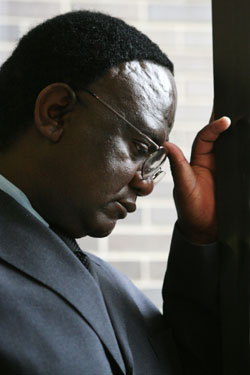
FREE AT LAST: Thanks to tireless efforts from Amnesty International, a relentless reporter and other human rights activists, Professor Felix Kaputu was freed from imprisonment in the Congo and is today working at Purchase, State University of New York. (Photo: Emmanuelle Françoy)
After more than four months in prison, Kaputu was freed and he returned to work the following day. However, his excitement at the prospect of teaching again waned quickly when he noticed there were soldiers outside the lecture hall guarding the door. It became clear that he would never again be free to teach and continue his research under this administration. The northern province of the Congo was intent on getting rid of intellectuals from the south and replacing academics with their own appointments. Kaputu suspected that the reason he was incarcerated in the first place was because of his close affiliation with the former president of Lubumbashi University who was an opposition member of the rebel organization, Rally for Congolese Democracy. Kaputu later assisted with his escape to Belgium; an act that resulted in Kaputu’s death warrant in the Congo.
News of professors, activists and journalists who just “happened to disappear” were all too common. Now, more than ever, his life was in danger. He made sure to always be accompanied by students when in public and took to never sleeping in the same place two nights in row. “Once you are accused, it’s forever,” Kaputu said.
“I am lucky to have learned so much from this suffering”
He needed to leave. Through contacts at the American Embassy in Kinshasa, Kaputu managed to get a visa before he escaped to the US via South Africa. Later he was informed that the official who gave him the exit stamp from the Congo was imprisoned for letting him leave the country. Once in the US, a colleague at the university referred Kaputu to Scholars at Risk.
Silencing scholars
“I am not a politician, I am a university professor, that is enough in a human life,” Kaputu said. His hope is that intellectuals and scholars can one day cooperate with the government on improving the situation in the Congo. But currently, the authorities seem intent on silencing scholars, intellectuals and political opponents. Kaputu, rather than succumbing to self-censorship like so many of his colleagues, insisted on teaching his students how to think critically, strive for truth and achieve gender equality.
“I grew up in a poor family and I have worked very hard to get this far,” Kaputu continued, stressing the word “very” and pausing for a second. He turned around and glanced at the bookshelf on the wall in his office, bursting with books on mythology and the history and people of the Congo. “I could have left but I decided not to,” Kaputu said, almost inaudibly and added, “In fact, my interest in the Congo can not just be extinguished, it is a part of my life.”
Kaputu is not only grieving the loss of his motherland, he is also filled with worry about the safety of his wife and three daughters who are still in the Congo. Because of him, they are under surveillance at all times. Kaputu has not seen them since the morning of his arrest and he never got to say goodbye to his deceased mother who suffered a stroke on the day he was arrested.
It looks like Kaputu is in the US to stay, at least for a while. Purchase College is prepared to assist in any way it can. For now Kaputu has to live in the moment and take every day as it comes. While he takes great joy in teaching, his wounds from the time spent in prison have not yet healed. With a death warrant looming in the Congo, it would not be safe for him to return.
He still feels threatened, even in the US.
“I very much panicked,” Kaputu said after attending a conference in Manhattan recently. The Congolese government delegation was in the same city. “I did my best to avoid members from the delegation; I am not ready to face them,” Kaputu explained.
He knows he has no choice but to stay in the US, even though all he can think about is going back to the Congo.
“It was not easy to accept this,” Kaputu said, and added softly, “But, you know I am lucky to have learned so much from this suffering.”
Professor Felix Ulombe Kaputu
- Received his Master’s of Arts degree in Ugaritic and Middle Eastern Mythology from the University of Lubumbashi
- Awarded his PhD. in 2000, specializing in gender issues, religion, and university pedagogy
- Research concentrated on gender issues and the impact of religion, particularly in Central Africa
- Recipient of international grants and awards from the Belgian CIUF-CUD (2001, 2005), the International Association of Oral History (2002), Fulbright (2003), the Japanese Foundation (2005), and the International Association for the Study of Religion (2005)
About the authors:
Marianne Onsrud Jawanda is the Norwegian editor-in-chief for the Norway Times, based in Pelham, New York.
Emmanuelle Françoy is a French photographer and artist, based in Pelham, New York.
This article was originally published in Global Knowledge no. 2, 2007.