
Å gjøre data tilgjengelig er relevant for de fleste fagområder i offentlig sektor, ikke bare innen økonomi eller fiskeri. Nylig har jeg skrevet flere artikler om hvordan institusjoner som forvalter kulturarven arbeider aktivt med å åpne sine data og digitaliserte verk for utviklere og for allmennheten. Dette gjelder arkiver, biblioteker og museer.
En av sakene går gjennom status på feltet og knytter utviklingen til foreslåtte endringer i reglene for offentlig sektors data. En annen sak tar spesielt for seg erfaringene det berømte Rijksmuseum i Amsterdam har høstet etter at de ved årsskiftet la om til en åpenhetslinje. Rådgiver Lizzy Jongma fortalte meg i et epost-intervju hvordan museet tenker om åpne data og tilgjengeliggjøring av digitaliserte verk. Nedenfor er intervjuet i sin helhet.
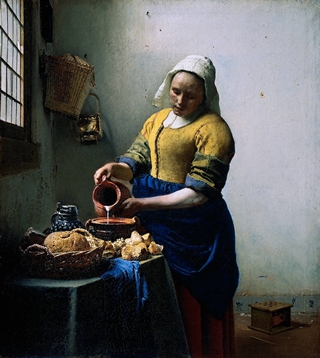
“Melkepiken” av Jan Vermeer. (foto: Rijksmuseum)
Et eksempel museet bruker er Jan Vermeers “Melkepiken” (The Yellow Milkmaid) fra ca. 1660. Mesterverket fantes i tusenvis av kopier på nettet, de fleste dårlig utførte reproduksjoner som ikke yter originalen rettferdighet. Ved å legge ut sin egen kopi i høy oppløsning håper museet å motarbeide en slik uheldig utvikling, som har ført til at besøkende i museets butikk ikke tror postkortene viser det riktige bildet!
Could you describe how publishing a high-res. image with open metadata helped? What kind of effects has it had?
Lizzy Jongma: “Since we started publishing our metadata with a URL to our high/higher res images (the images are jpegs with a file size up to 5mb/ 300 dpi. We have Tiff images in much higher resolutions but we don’t put these images online) we’ve had a lot of attention for our collection. From media, from app builders, programmers and from our colleagues. Their main focus was with the fact that we shared our high res images online with a CC-BY license.
It has helped us tremendously in promoting our (online) collection. We want everybody to know (parts of) our collection and use our digital collection for any/your own purposes: if you want to do a powerpoint about Vermeer or Rembrandt, then please use our images and information instead of the ugly and bad images that are on the internet (that is what we mean with the Yellow Milkmaid anecdote. If you use Google images to find this painting of Vermeer, then you will find very ugly images that don’t do any justice to the beautiful, fresh original painting). We are a public institution and it is our mission and goal to share our collection and knowledge with everyone. We have seen an increase in visitors to our online collection. And we also benefit from that: we get e‑mails every day from experts in all sorts of fields that help us annotate our collection or correct us if we’re wrong.
Since we put an API online (for developers and programmers so that they can integrate our collection in their own applications or website) we’ve had over a dozen new (free) apps built with our collection. Some are nice and some are really useful and innovative. On www.rijksmuseum.nl/api you can find a list with apps. Arkyves built a great app: an iconographic browser to search our collection thematically. The browser is available in English, Italian and French. Our collection metadata is in Dutch and this is the first international entry to our collection!
AB_C Media built a “faces of the Rijksmuseum” app: using face recognition software they were able to isolate all the faces on our paintings. This can help us in creating more specific, more detailed descriptions of our paintings (for instance pinpointing everyone on the Nightwatch).
Our Open Data was also harvested by national and international platforms and portals: Artstor, the Dutch museums collection website, Kennisnet (the national infrastructure for e‑learning in schools in the Netherlands). We are now partnering with the VU University (an Amsterdam Based University with which we have been partnering for years in developing semantic tools) to develop crowdsourcing and semantic annotation tools based on our Open Data and so on. In short: we’ve had a lot of attention and concrete results that help us promote and further annotate our collection.”
Are there now fewer bad copies around on the web? Do more people find the high-res image on your website and is it being republished on other sites?
“No: the bad copies aren’t gone. Unfortunately. We’ve only had our Open Data online for three months, and unfortunately most bad things stay on the internet forever. We do see an increase in the usage of our online collection and images. By giving Wikipedia, Europeana and Kennisnet access to our metadata and images we hope that kids and teachers and so on will get to know the good (high res, colour balanced, not photoshopped) images. We’ve also done a lot of work in optimizing our online collection for search engines like Google and we hope that our collection will end at the top of Google searches over the next year, but decreasing the amount of poor images is a long term strategy.”
In general, what is the Rijksmuseum’s policy regarding publishing metadata and making public domain works available? How will making more data and content available help your work?
“The Rijksmuseum policy is (as said) about sharing our collections and knowledge with everyone (if possible: we do have to stay within copyright boundaries). We now have 100.000 objects in our Open data collection (all with images) and 250.000 objects (not all with images) in our online collection and we will continue to digitize our collections as part of our daily work. Sharing helps us to promote our collections. The public wants to see our collection, create new products, build new applications (showcase applications with our collection) and share knowledge with us about the collection. Open Data didn’t change our work (we were already digitizing and annotating our collections) and it helps us fulfilling our mission and goals.
We now advice other Dutch museums (together with Kennisland, the CC representative in The Netherlands) in implementing Open Data and Copyright issues concerning open data. We also entered our API in different Hack Battles and will present our project at Museums and the Web.”